Awe Walks: Why Looking Up Can Make You Feel Better
An eight-week study found that short weekly walks spent looking for wonder lifted older adults' moods. Here is what awe is and how to take an awe walk.
Walter is 72, and every morning he takes the same loop around his neighborhood. For years he walked it with his eyes on the sidewalk, thinking about bills, his knees, and whether his grandkids would call. One cool morning he stopped at the corner and, for no real reason, looked up. The oak tree at the end of the block was huge. Above it, thin clouds were moving across a pale blue sky. Walter pushed his glasses up his nose and just stood there for a minute. He felt small, but in a good way. When he got home, he felt lighter than he had in weeks.
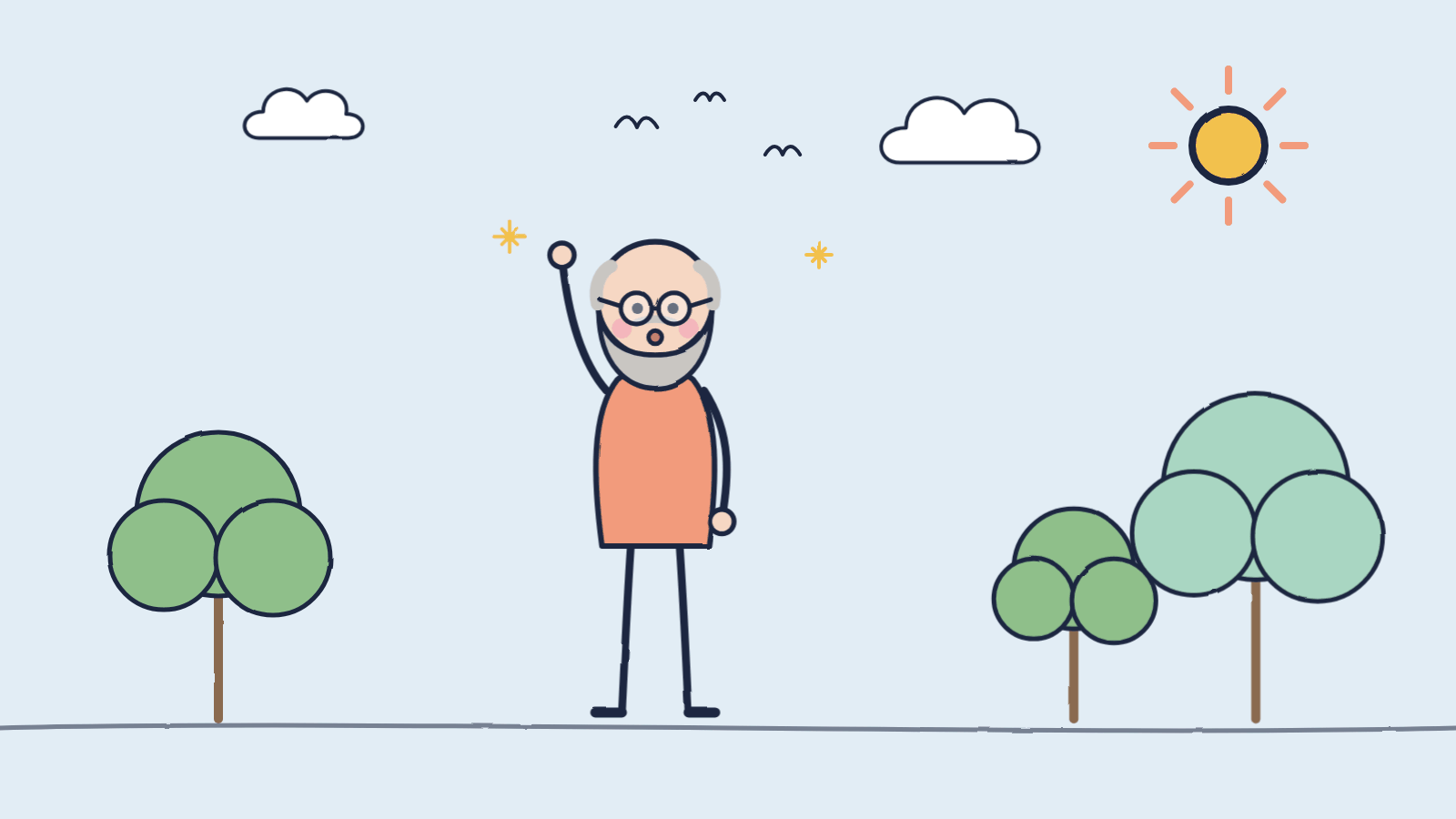
What Walter felt has a name. It is called awe, and scientists have started to study it closely.
What is awe?
In 2003, psychologists Dacher Keltner and Jonathan Haidt wrote a well-known paper about awe. They described it as the feeling we get when we meet something vast, something much bigger than ourselves. That could be a mountain, a starry sky, a piece of music, or even a very kind act.
They said awe has two key parts. The first is vastness, the sense that something is huge in size, power, or meaning. The second is what they called a “need for accommodation.” That is a fancy way of saying the experience does not fit neatly into what we already know, so our minds have to stretch a little to take it in.
You do not need the Grand Canyon. A big old tree or light through leaves can do it too.
The awe walk study
In 2022, a team led by Virginia Sturm, with Dacher Keltner among the authors, tested a simple idea. Could taking “awe walks” help older adults feel better?
They worked with 60 healthy older adults. Each person took a 15-minute walk outside once a week for eight weeks. Half were randomly picked to take awe walks. They were encouraged to notice vast things and small details with fresh eyes. The other half took regular walks.
During each walk, people took a selfie. Here is where things got interesting. Over time, people in the awe group took photos where they themselves filled less of the frame and more of the scenery showed. Their smiles also got bigger. That is where the study got its name: “Big smile, small self.”
The awe walkers reported feeling more awe during their walks. In their daily lives, they also reported more positive feelings that connect us to others, like compassion and gratitude, and they reported less daily distress than the regular walkers.
Why might a “small self” help?
It sounds strange that feeling small could feel good. But when Walter looked up at that tree, his worries did not disappear. For a moment, they just took up less space.
Researchers think this may be part of why awe can lift our mood. It gently moves the spotlight off ourselves and onto the world around us, and often onto other people too.
What this can and cannot do
It is worth being honest about the limits. The awe walk study was fairly small, and all the people in it were healthy older adults. We do not know for sure if the results would be the same for everyone.
The study also found some things that did not change. Measures of anxiety, depression, and overall life satisfaction did not shift in either group. So an awe walk is not a treatment for depression or anxiety, and it is not a replacement for care from a doctor or therapist. If you are struggling, please reach out to someone you trust or a professional.
What the research does suggest is that a short, gentle habit of looking for wonder can bring a few more good feelings into ordinary days. For 15 minutes a week, that seems worth a try.
Try it this week
Here is a simple way to take your own awe walk:
- Pick a time and a place. Choose 15 minutes once a week. A park is lovely, but a city street works too.
- Walk somewhere a little new, if you can. A different route can make it easier to see things with fresh eyes.
- Look up and look closely. Notice the size of the sky or a tall building. Then notice tiny things, like the pattern on a leaf.
- Leave your phone in your pocket. Take it out for one photo if you like, but try to spend most of the walk just looking.
- Breathe and pause. When something catches your eye, stop for a few breaths and let yourself take it in.
If you cannot walk easily, sitting by a window and watching the clouds can be a gentle version of the same idea.
The tree at the end of the block
Walter still walks his loop every morning. Now he makes a point of stopping at the old oak and looking up, even on gray days. Some mornings the sky is plain, and that is fine. He has found that there is almost always something worth noticing if he gives it a minute. If you would like a place to keep your own small moments of wonder, NOTETYPE lets you write a thought and press “Make it real” to see doodles bloom around your words, all kept private on your device.
Sources
- Keltner, D., & Haidt, J. (2003). Approaching awe, a moral, spiritual, and aesthetic emotion. Cognition and Emotion, 17(2), 297–314.
- Sturm, V. E., Datta, S., Roy, A. R. K., Sible, I. J., Kosik, E. L., Veziris, C. R., Chow, T. E., Morris, N. A., Neuhaus, J., Kramer, J. H., Miller, B. L., Holley, S. R., & Keltner, D. (2022). Big smile, small self: Awe walks promote prosocial positive emotions in older adults. Emotion, 22(5), 1044–1058.